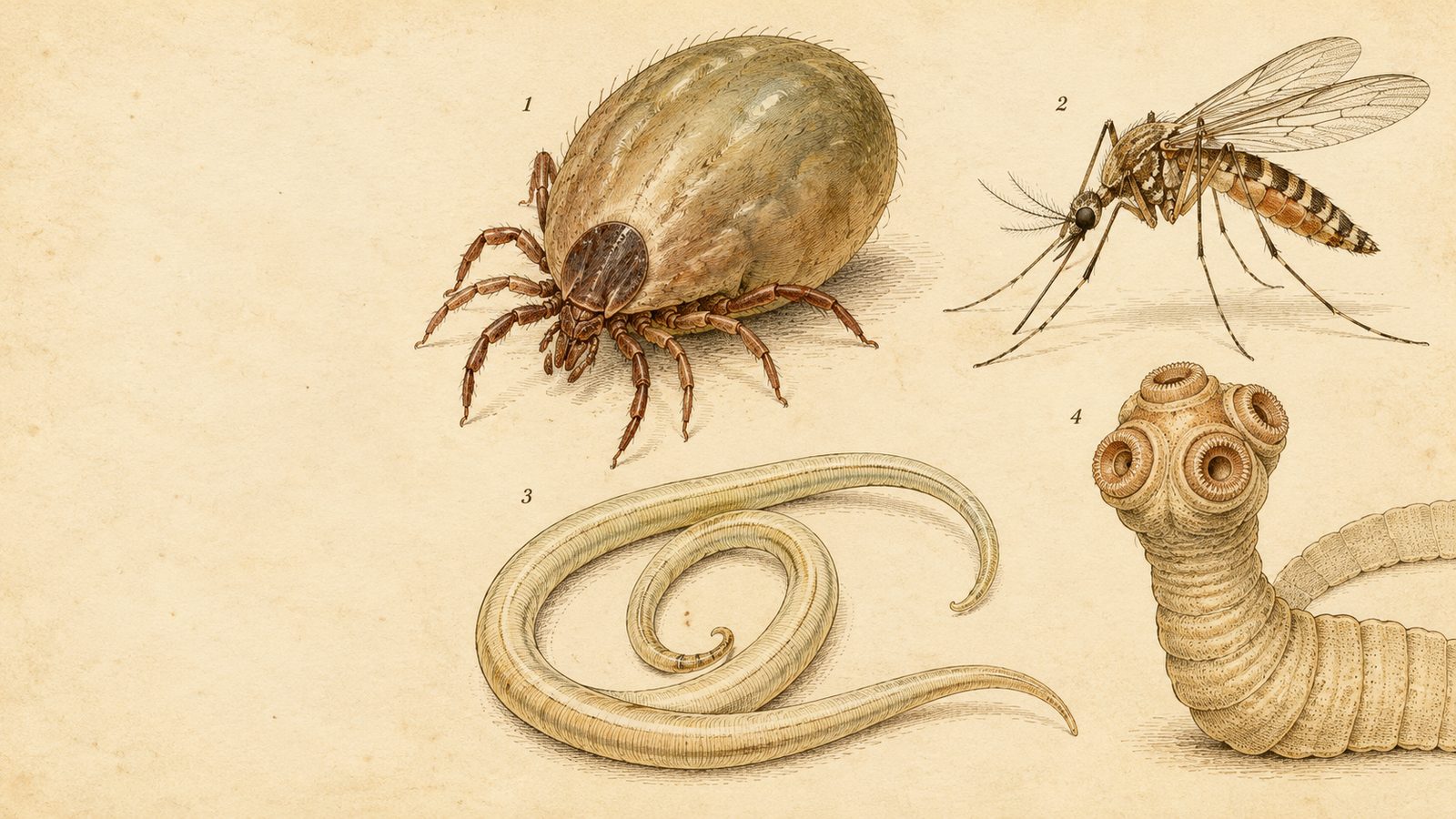
A field guide to parasitology
Journal of Parasite Research
Research on parasites and parasitic diseases of humans and animals, from parasite biology and host responses to transmission, diagnosis, treatment and control.
- Publisher
- Open Access Pub
- ISSN (online)
- 2690-6759
- License
- CC BY 4.0, authors retain copyright
- Publishing since
- 2019
An index of what the journal publishes
The journal publishes original research, reviews and other scholarly work on parasites and parasitic diseases of humans and animals, basic and applied, across laboratory, clinical, veterinary and field settings.
Protozoa
Including Plasmodium, Toxoplasma, Leishmania, trypanosomes, Babesia, Cryptosporidium, Giardia and Eimeria.
Helminths
Nematodes, trematodes and cestodes, including soil-transmitted helminths, schistosomes and filarial worms.
Arthropods and vectors
Ticks, mites and insects as parasites and as vectors, including mosquito and tick biology and vector control.
Hosts and settings
Human, livestock, companion animal and wildlife hosts, including zoonotic transmission and One Health research.
Approaches
Biology and life cycles, host–parasite interactions and immunology, molecular parasitology, epidemiology, diagnosis, treatment, drug resistance and antiparasitic compounds.
These areas are examples, not a closed list. Read the full Aims and Scope.
Latest articles
A selection of the most recently published articles.
Prevalence and Risk Factors of Intestinal Parasitic Helminths among Primary School Children in Oru West Lga, Imo State, Nigeria
Onwuka Chigozie Divine
- Volume 1, Issue 3
Risk Factors and Control Strategies for Cattle Tick Infestations in Nigeria: Influence of Acaricide Application Methods, Hand-Picking Frequency, and Herd Mobility in Plateau State
Biallah Markus Bukar, Uchechukwu C. Ohaeri, Henry Madubuike, Gloria Karaye, Mark Kparmark, Benkaat Maxwell Davwet, Dogo Abraham Goni
- Volume 1, Issue 4
- DOI 10.14302/issn.2690-6759.jpar-25-5576
Parasitological Examination of Fecal Samples from Sheep, Goats, and Cattle at the Techiman Slaughterhouse
Prince Kyere Dwaah, Nana Yaa Awua-Boateng, Anothny Osei-Tutu, Solomon Bakyaayele, Mohammed Abdul-Nafiw Leppode
- Volume 1, Issue 4
- DOI 10.14302/issn.2690-6759.jpar-25-5392
Helminth parasites prevalence and distribution among Sheep in Gudaya Bila District, East Wallaga, Ethiopia
Gemeda Tesema, Solomon Tesfaye, Damtew Bekele
- Volume 1, Issue 3
Editors
Manuscripts are handled by editors with expertise in human, veterinary and molecular parasitology.

Dabbu Jaijyan
Assistant Professor, Virginia Commonwealth University, Richmond, Virginia, United States
How the journal works
Peer review
Single-blind by default; double-blind review is available on request. Manuscripts that proceed to external peer review are normally evaluated by at least two independent subject-matter experts.
Open access and license
Articles are free to read on publication under the Creative Commons Attribution 4.0 (CC BY 4.0) license. Authors retain copyright.
Article processing charge
Payable only after acceptance; withdrawal after submission is subject to the journal's withdrawal policy. Fee-relief inquiries are considered case by case; contact the editorial office before or at submission.
Ethics and reporting
Human and animal research requires ethics approval, and informed consent or a waiver documented by the ethics committee, where applicable. See the Editorial Policies.
DOIs and preservation
Articles receive Crossref DOIs and are deposited in Portico for long-term preservation. Read our preservation policy.
Data and sequences
Every empirical research manuscript must include a data-availability statement. New sequences are deposited in GenBank, ENA or DDBJ.
Submitting a manuscript
- Primary route
ManuscriptZone
Submit and track your manuscript through the publisher's submission system.
- Alternative route
Submission form
A single-page form, with the Journal of Parasite Research preselected.
- Assisted route
Editorial office
For help with submission, write to info@openaccesspub.org.
Authors must use only one submission route for the same manuscript.
Before submitting, read the Instructions for Authors and the Editorial Policies. The article processing charge is payable only after acceptance; withdrawal after submission is subject to the journal's withdrawal policy.